Abbenay
The DispossessedAbbenay is the largest settlement and the intellectual center of Anarres: a city whose name means “Mind,” whose neighborhoods are organized in a cellular pattern, and whose existence tests whether a complex society can remain decentralized. Its plain buildings, wind turbines, shared facilities, and connections to distant communities express the Odonians’ effort to make cooperation—not a capital or ruling authority—the basis of civic life. Yet drought, informal control, and political debate repeatedly expose the strain between that ideal and the institutions needed to keep the city alive.
From mining outpost to “Mind”
Anarres was explored for two centuries without being colonized, but its mineral deposits became important after Urras’s own lodes were exhausted. In the Urrasti year IX-738, a settlement for mercury miners was established at the foot of the Ne Thera Mountains in Ans Hos and called Anarres Town. It was a temporary, overwhelmingly male mining post: workers signed on for two or three years and then returned to what they regarded as the real world.
A different settlement took shape after the collapse of Thu’s government in 771. Thu had secretly maintained a rocket base and a community of gold miners, including families, on the Moon. When the Council of World Governments proposed transferring Anarres to the International Society of Odonians, the mining settlement was evacuated; some of the gold miners chose to remain on the desert world. For more than twenty years, twelve ships carried the Odonian settlers across the divide between the planets. When the million people who had chosen the new life had arrived, immigration was closed and the port was left open only to freight ships under the Trade Agreement. The former Anarres Town, by then home to one hundred thousand people, had become Abbenay, “Mind.”
A decentralized city built for exchange
Decentralization was central to Odo’s social plan. She did not propose abolishing cities; rather, she imagined communities connected by communication and transport so that goods and ideas could circulate and no settlement would be cut off from change. The network was not to be governed from above. Odo envisioned no capital, controlling center, or permanent bureaucratic establishment capable of turning coordination into rule.
Anarres’s aridity complicated that design. Communities had to spread widely in search of resources, and few could support themselves alone. The settlers nevertheless refused to retreat into pre-urban tribalism: they maintained a complex, industrial society, building roads before houses and continually exchanging the distinct resources and products of each region. Abbenay is both the hub of that circulation and a city made in its image. Its repeated neighborhood units contain workshops, factories, residences, dormitories, learning centers, meeting halls, distributories, depots, and refectories. Heavy industry and food processing cluster near the outskirts, while related industries gather around particular squares and streets.
The textile district gives this organization a public face. Squares lined with holum-fiber processing plants, spinning and weaving mills, dye works, and clothing distributories display banners and pennants in the dyers’ full range of colors. The city’s common pattern is not sameness without distinction: local work is legible, and its products move through a wider network. Abbenay’s form thus joins neighborhood-scale organization to interdependence across the planet.
The built environment and organic economy
When Shevek approaches Abbenay by dirigible, its plain appears as an exceptional green landscape. The vivid fields depend on Old World grains that grow in only a few warm regions of Anarres. At nine, Shevek had cared for delicate ornamental plants in Wide Plains; seeing the green again recalls the old man who taught him that exacting work, dirt, fish-oil manure, and new leaf buds could belong together in his memory of home. The city’s approach is therefore also a return to particular experiences of cultivation and care.
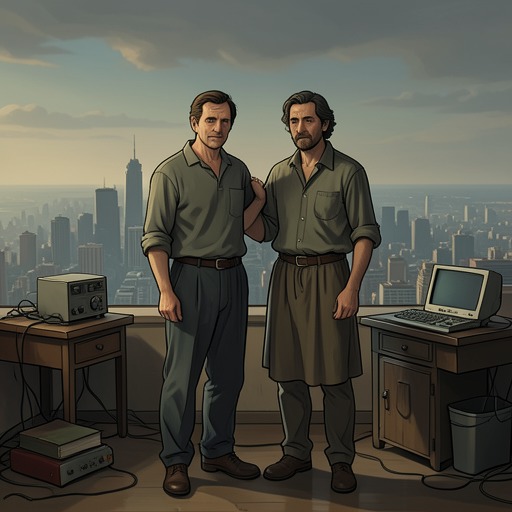
Abbenay’s streets are broad and clean, its buildings low, and its wind turbines rise in spare towers. Earthquakes help explain the mostly single-storey construction and small, tough windows; the plentiful windows admit natural light, since artificial lighting is not provided from an hour before sunrise until an hour after sunset. Heat is not supplied when the outdoor temperature exceeds 55 degrees Fahrenheit. These limits do not mean that the city lacks power: wind turbines and earth-temperature-differential generators provide energy. They reflect the society’s commitment to organic economy, which makes restraint an ethical and aesthetic principle as well as a practical one. Odo’s phrase, “Excess is excrement,” is rendered into an urban environment that is bright, bare, quiet, and visibly economical.
Festival, drought, and strain
Abbenay’s public life includes traditions that join work to shared celebration. On Insurrection Day, a midsummer festival commemorates the first great uprising in Nio Esseia in the Urrasti year 740. Cooks and refectory workers are honored because a cooks’ and waiters’ syndicate began the strike that led to the insurrection. The feast takes place in North Park, where Shevek and his companions talk after a long afternoon of cooking, eating, and dancing. The holiday gives collective labor a place of honor, while the political conversation reveals that solidarity does not eliminate disputes over power.
Takver, recently returned from a long afternoon of dancing and feasting, challenges the reassignment of biologist Kvigot to fisheries work at the Keran Sea while Turib takes over his research program. Her research syndicate has been absorbed into a project managed directly by PDC, and she suspects that political loyalty, rather than scientific merit, is shaping who will direct the work. Her complaint brings the problem of informal influence into the festival itself: a city built to resist central control can still see research and labor channeled through administrative decisions.
Environmental scarcity is more than an abstract limit in Abbenay. During a dry year, residents discuss the failed leaf crops in Southrising and the long absence of rain; winter then arrives early, cold, and dry. Frozen dust blows through the low streets. Water for baths is strictly rationed because food and drink take priority over cleanliness, and the twenty million inhabitants of Anarres depend on holum plants for leaf, seed, fiber, and root. Warehouses contain some reserve textiles, but food has never been stored in comparable abundance. Water is directed to the land to keep crops alive, while dust from the south and west turns the sky yellow. The city’s sparse design reflects a deliberate ethic, but the drought shows how little room remains between disciplined economy and deprivation.
Abbenay as a civic and political meeting place
The city’s streets and institutions are also crossed by competing claims about freedom. Shevek returns to Abbenay on a windy autumn night after a train journey delayed by scarcity and conflict. Having traveled the final five hundred miles from Equator Hill in a truck-train convoy, he runs three miles through the dark streets to his home, expecting to find Takver and Sadik. They are gone, and a letter explains that Takver has received an emergency posting to a laboratory in Northeast. The bright, active city he later inhabits is also the place where separation becomes a fact of domestic life.
Abbenay’s political life is not confined to the formal center. At a meeting in the PDC building, Bedap hears of a weak, unscheduled radio message from the Odonian Society in Benbili, a group that asks whether it can send settlers to Anarres. The proposal presses the city’s institutions to confront the difference between accepting people and preserving the rules that protect the settlement from unrestricted entry. In a later dispute, participants invoke the closure terms: passengers may not leave freight ships beyond the boundary of the Port of Anarres. The port’s boundary and Abbenay’s political deliberations show how a society founded on migration and mutual aid can also regulate who may cross its threshold.
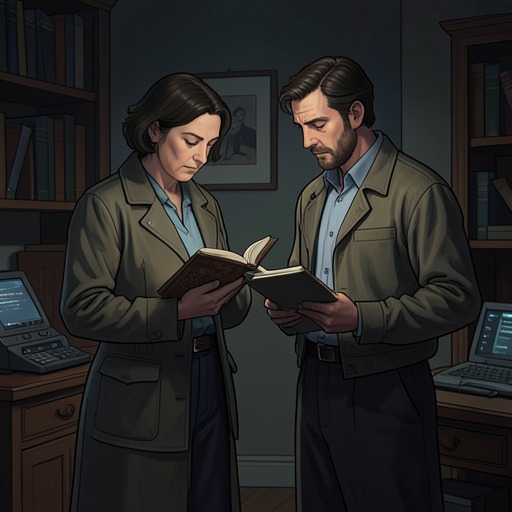
Shevek ultimately resolves to return to Abbenay with Takver and establish an independent printing syndicate. It will print the uncut Principles of Simultaneity, Bedap’s work on open science education, which PDC would not circulate, and Tirin’s play. The choice makes the city a site not only of administration and technical work but of renewed initiative outside official approval. In Abbenay, the ideal of a decentralized society is neither a settled achievement nor an empty slogan: it is tested in the everyday organization of production, in drought and distribution, and in the question of who can speak, publish, and join the community.